Learning Outcomes:
i. After completing this lesson, students will be able to:
ii. Explain how cellular respiration utilizes proteins and fats as energy sources.
iii. Describe the conversion pathways of proteins and fats into molecules that can enter the main cellular respiration pathway.
iv. Discuss the energy yield from the breakdown of proteins and fats compared to glucose.
Identify the role of enzymes in the breakdown of proteins and fats.
Introduction:
Glucose, the simple sugar derived from carbohydrates, is the primary energy source for most cells. However, organisms can also utilize proteins and fats as alternative energy sources, especially during periods of glucose scarcity or when the demand for energy is high. The cellular respiration of proteins and fats involves a series of enzymatic reactions that break down these complex molecules into smaller components that can enter the main cellular respiration pathway, which ultimately generates ATP, the energy currency of cells.
i. Cellular Respiration of Proteins:
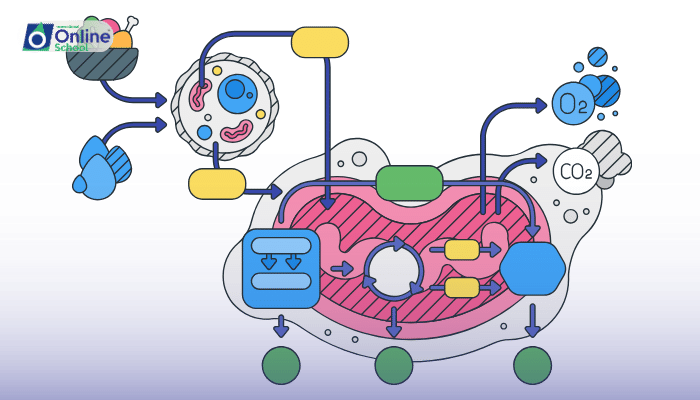
The breakdown of proteins, a process known as proteolysis, begins with the action of proteases, enzymes that cleave peptide bonds, the linkages between amino acids. The resulting amino acids are then further processed to yield acetyl-CoA, a two-carbon molecule that can enter the Krebs cycle, a central component of cellular respiration. The Krebs cycle generates high-energy electron carriers, NADH and FADH2, which are subsequently oxidized in the electron transport chain, leading to the synthesis of ATP.
ii. Cellular Respiration of Fats:
Fats, also known as triglycerides, are broken down into fatty acids and glycerol through a process called lipolysis. Fatty acids, particularly long-chain fatty acids, are then activated by Coenzyme A (CoA) to form fatty acyl-CoA molecules. These molecules undergo a series of reactions known as β-oxidation, which cleaves the fatty acid chain into two-carbon acetyl-CoA units. Acetyl-CoA, just like from protein breakdown, enters the Krebs cycle and contributes to ATP synthesis.
iii. Energy Yield from Proteins and Fats:
The breakdown of proteins and fats generally yields more energy per molecule than the breakdown of glucose. This is because proteins and fats are larger and more energy-dense molecules. For instance, the complete oxidation of a fatty acid can generate up to 146 ATP molecules, while the oxidation of glucose yields 38 ATP molecules.
iv. Role of Enzymes:
Enzymes play a crucial role in the breakdown of proteins and fats. Specific enzymes are responsible for each step of the degradation pathways, ensuring the efficient and controlled release of energy from these molecules. Proteases, lipases, and fatty acyl-CoA synthetase are just a few examples of enzymes involved in the cellular respiration of proteins and fats.
Cellular respiration is not limited to glucose as an energy source. Proteins and fats can also serve as alternative fuels, providing cells with the energy they need to function and maintain homeostasis. The breakdown of proteins and fats involves complex enzymatic pathways that ultimately converge with the main cellular respiration pathway, leading to the generation of ATP, the essential energy currency of cells. Understanding these metabolic processes provides insights into the adaptability of organisms to various nutrient sources and their ability to maintain energy production under different environmental conditions.
